

Sleep aid for babies: What really helps and what probably doesn't
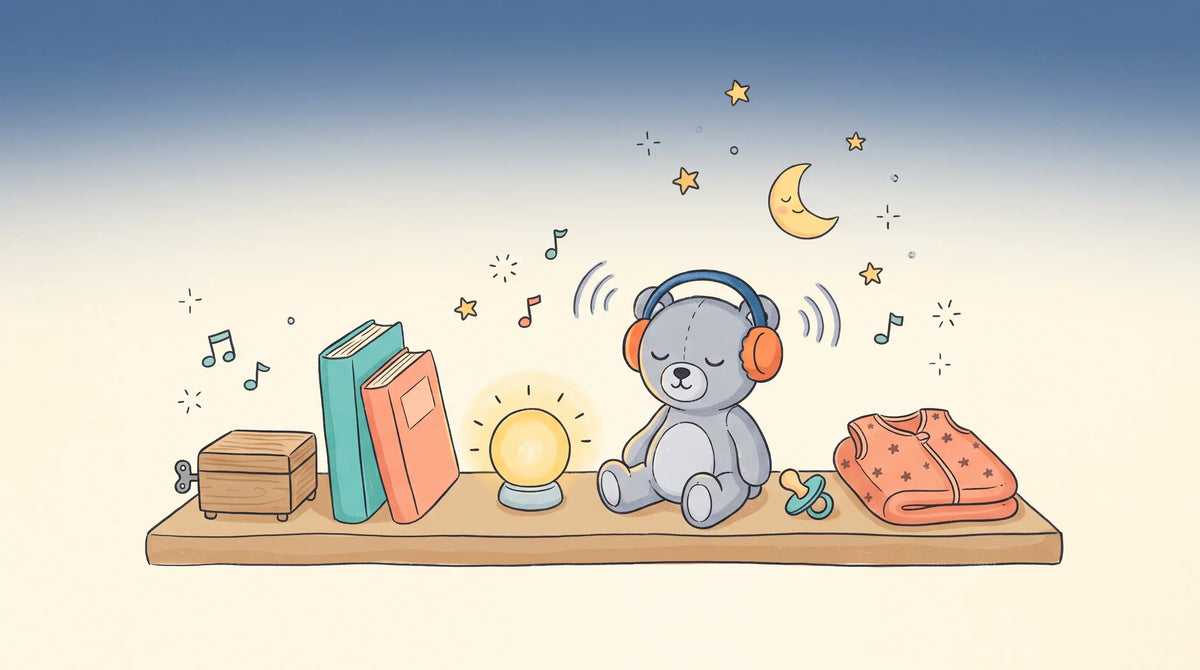
Your baby is tired, but just won't fall asleep? You're not alone. There is a sleep aid for sale for almost every sleep problem, from white noise machines to glowing stuffed animals. They are used less than the selection might suggest.
Here you will find an honest overview of sleep aids for babies: what is suitable at what age, what studies and expert organizations say about them, which aids are more likely to be unfavorable in the long term, and what to look for when buying.
For transparency: We are Lenabo and we make stuffed animals with speakers that play sleep melodies and sleep sounds. We present our product in its own section at the end. All other recommendations are manufacturer-independent.
The most important things in brief
- Best supported: an evening ritual that follows the same routine every night.
- Simple and helpful: closeness, a pacifier, a music box, quiet music, or consistent white noise with a distance and timer, and dimmed light.
- Unfavorable in the long term: aids that you cannot provide every night, such as carrying or driving the stroller until your baby falls asleep.
- Not in the baby crib: no stuffed animals, pillows, blankets, or devices during the first year of life. No oils containing camphor or menthol.
- Falling asleep on their own: From about 4 months, it helps to put your baby down tired but still awake.
What is a sleep aid?
A sleep aid is anything that makes the transition from wakefulness to sleep easier for your baby. This can be closeness, such as breastfeeding, bottle-feeding, or rocking, a fixed routine like the evening ritual, or an object like a pacifier, music box, or stuffed animal.
Babies associate falling asleep with what happens during the process. This is practical, but it has a downside: All children wake up briefly several times at night. If the usual aid is missing, many demand it again, as pointed out by the German Federal Institute for Public Health (BIÖG). Good sleep aids are therefore those that your child can find again at night or that you can easily repeat.
Which sleep aid is suitable for which age?
Age |
What often helps |
What to look out for |
|---|---|---|
0 to 3 months |
Closeness, breastfeeding or bottle-feeding, carrying and rocking, a quiet song, or consistent white noise |
If your baby falls asleep while being carried, in a car seat, or in a rocker, put them on their back in bed soon. Introduce a pacifier only after breastfeeding is well established. |
3 to 6 months |
a short, always the same routine, music box, pacifier |
From about 4 months, put them down tired but still awake. Stop swaddling at the latest when your baby wants to roll over. |
6 to 12 months |
fixed evening ritual of about 30 minutes, sleep melody, dimmed light |
End the daytime nap about four hours before bedtime. Still nothing in the crib. |
1 to 3 years |
Book or bedtime story, stuffed animal or cuddly cloth in bed, dim night light |
No screens for falling asleep. Try to wean them off the pacifier after the first birthday as much as possible. |
Based on the recommendations of BIÖG, AAP, and WHO. Every child is different.
10 sleep aids at a glance
Not every sleep aid is suitable for every child. Try out what works for you calmly, and then stick with it for a while. Babies need repetition until something becomes a signal for the night.
1. A fixed evening ritual
There is the best evidence for this. In a study with 405 mothers, children between 7 and 36 months fell asleep faster and woke up less often after two weeks with a fixed evening ritual compared to the control group. The BIÖG calls it around 30 minutes that your child experiences as pleasant. Ideas and a routine by age can be found in our guide to bedtime rituals for babies.
2. Closeness: Breastfeeding, bottle-feeding, and cuddling
In the first weeks, many babies fall asleep at the breast, with a bottle, or in your arms. This is normal and often the easiest. Children get used to it, however, and demand it at night too, the BIÖG writes. If it costs you too much strength at some point, you can gradually separate closeness from falling asleep.
3. Carrying and rocking
Steady movement quickly calms many babies. If your baby falls asleep while being carried, in a baby carrier, in a car seat, or in a rocker, put them on their back on a firm sleep surface as soon as possible, the American Academy of Pediatrics AAP advises. If every falling asleep becomes a walk, the section on weaning further down will help.
4. Pacifier
Sucking calms. Studies also indicate that a pacifier when falling asleep can lower the risk of sudden infant death, writes the BIÖG. If you breastfeed, only offer it when breastfeeding is well established, at the earliest from the second or third week of life. And do not force it on your baby. If it falls out during sleep, do not put it back in. A band around the neck or clothing and sweets with sugar or honey are taboo.
5. Music box and quiet music
A music box also holds the BIÖG for a useful sleep aid. It is important that the same melody plays every night, so it becomes a signal for the night. The device stands at a distance next to the bed, not in it, and pull cords or cables remain out of reach. More on this in our guide Music box for babies.
6. White noise and other sleep sounds
Steady white noise, rain, or ocean sounds cover everyday noises. In a small study with newborns, 16 out of 20 babies fell asleep within five minutes with white noise, 5 out of 20 without white noise. A review of 38 studies evaluates the evidence overall as very weak. The AAP advises placing sleep devices as far away as possible, setting them as quiet as possible, and limiting the duration of use. More on this in our guide to white noise for babies.
7. Dimmed light
Low light shows your baby: Now it is night. The BIÖG advises a bedroom with low light and without noise, at night a dimmed light and a quiet voice are enough. A night light with warm, weak light helps with breastfeeding and changing, without everyone becoming wide awake.
8. Sleep sack and pleasant temperature
Whoever is cold or sweats falls asleep poorly. The BIÖG recommends 16 to 18 degrees in the bedroom and a sleep sack instead of a blanket, whose neck opening is no larger than your baby's head. What else belongs in the baby crib is in our guide to the safe sleep environment.
9. Swaddling, only with caution
Swaddling involves wrapping a newborn tightly in a cloth. Some babies are calmed by this, but the professional association of pediatricians advises against it. It refers to studies with a higher risk of sudden infant death, especially on the stomach, and also to overheating and hip problems (BIÖG). If you still swaddle, only put your baby on their back and stop as soon as they want to roll over at the latest. According to the AAP, this is usually at 3 to 4 months, sometimes earlier.
10. Stuffed animal or cuddly cloth
A stuffed animal for falling asleep provides comfort and accompanies many children for years. In the first year of life, however, it does not belong in the baby crib: The sleep recommendations of the BIÖG call for "no bumpers, furs, stuffed animals, or the like in the crib", the AAP sees it the same way. Elsewhere, the BIÖG considers a small stuffed animal that cannot cover the face to be unproblematic. We stick to the stricter recommendation: Until the first birthday, the stuffed animal is part of the daytime and evening ritual, after that it may go into bed.
Which sleep aids are unfavorable?
Unfavorable are especially aids that you cannot or do not want to sustain in the long term. The BIÖG mentions babies who only calm down while being carried around, in the stroller, or at the breast, and are then put to sleep in bed. For toddlers, driving around in the car is added. Such habits are demanded loudly by children later, also at night. Exceptions are fine, for example in case of illness or in a foreign environment, they should just not become the rule.
Some sleep aids can also harm your baby:
- Continuing to sleep in a car seat, rocker, or carrier: For falling asleep, this is fine, for continuing to sleep, your baby belongs on their back in bed.
- Bottle for constant sucking: Milk and juice attack the teeth, cavities often start on the upper incisors. As a thirst quencher, water or unsweetened tea are suitable, advises the Dental Service of the Region Hannover.
- Essential oils and cold balm: Camphor and menthol are generally not suitable for infants and toddlers. Even the smallest amounts can lead to life-threatening laryngeal spasms and respiratory arrest according to the Federal Institute for Risk Assessment. For eucalyptus and peppermint oil, special caution is advised under three years.
- Hair dryer, vacuum cleaner, and loud devices at the bed: The BIÖG advises against the hair dryer as a sleep aid, also because of heat and electricity near the bed. Sleep devices can also be surprisingly loud: In a measurement of 14 devices, three were above 85 dB at full volume.
- Weighted blankets and sleep sacks: The AAP advises against anything weighted on or next to the baby.
- Screens: For children under two years, the WHO advises completely against screen time, including the video for falling asleep.

Important for babies: In the first year of life, your baby sleeps most safely on their back, in a sleep sack, in their own bed in the parents' bedroom, not too warm and smoke-free. No pillows, blankets, bumpers, furs, or stuffed animals belong in the crib, as recommended by the BIÖG. Sleep devices also stand next to it, not in it.
How do I wean a sleep aid again?
If a sleep aid works well for you, you don't have to change anything. If it costs you a lot of strength every night, it can be replaced. A weaning is possible, but usually exhausting, writes the BIÖG. It advises to proceed step by step and stay consistent, you determine the pace.
This is what it can look like when your baby only falls asleep with movement:
- Rock less. Rock or carry your baby until they are sleepy, and put them in bed before they have fallen asleep.
- Calm down in bed. A hand on the stomach, quiet humming, or the usual melody replace the movement.
- Sit next to it. Later you only sit at the bed instead of lying down, and leave when your child has fallen asleep.
- Stay with it. Do it the same every time falling asleep, also during the day. Your child should feel that you accompany them lovingly.
Sleep training programs like "Ferbern", where children cry alone for a set time, are generally recommended by the BIÖG only from one year. They are controversial in the professional world and can greatly strain the child and parents, gentler ways should come first. If sleep problems persist or strain you a lot, talk to your pediatrician.
Buying a sleep aid: What you should look out for
Whether a stuffed animal with music, music box, white noise machine, or night light: With sleep aids with technology, a second look is worth it.
- Volume: finely adjustable and also completely quiet. A limitation of the maximum volume is practical.
- Timer: A sleep timer or an automatic shut-off ensures that nothing runs all night.
- Cables and cords: out of reach of your baby and not near the bed, as advised by the AAP.
- Batteries: The battery compartment should be screwed, because swallowed button cells can cause severe burns, warns the BfR.
- Washable: With stuffed animals, the technology should be removable.
- Light: warm, weak, and dimmable, not directed directly at the face.
- Promise: Caution with products that promise to lower the risk of sudden infant death. There is no evidence for this according to the AAP.
Lenabo as a sleep aid
A Lenabie is a stuffed animal with a removable speaker. From birth, it plays sleep melodies and its own sleep sound: with Aaron, the bear, white noise, with Lina, the cloud, rain, and with Nalu, the surfboard, ocean waves. You can find audio samples in our audio content. Later, the same Lenabie tells bedtime stories and audio plays with its own voice, then learning content is added. This way, the sleep aid remains familiar, while the evening ritual changes.
In the first year, the Lenabie stands at a distance next to the bed, not in it. In the app, you set the volume, can limit the maximum to 60%, and set a sleep timer. The maximum volume of the speaker is limited to 85 dB, measured at a distance of 50 cm. This is a technical upper limit, not a recommendation: For babies, as quiet as possible applies. Without a speaker, the Lenabie is a completely normal, washable stuffed animal at 30 °C, which after the first birthday may also go into bed.
To be honest: A sleep aid does not have to cost anything. A song that you sing every night is also a signal for the night. A Lenabie is worth it if you want a melody, sleep sound, and later stories in a stuffed animal that grows with your child.
Price: The starter kit with speaker, one Lenabie of your choice and its contents costs €99.99, with free shipping in Germany.
Frequently Asked Questions
Which sleep aid really helps?
A bedtime routine that follows the same pattern every night is best supported by evidence. The evidence base for sounds such as white noise is thin, but they do help some babies. In the end, what matters is what works for your child and what you can stick with every night.
When can you start using a sleep aid?
Closeness, a song and dimmed lights are suitable from birth, and soft music or white noise can also be used at a distance. If you breastfeed, only offer a pacifier once breastfeeding is well established, at the earliest from the second or third week. A soft toy in bed should only be introduced after the first birthday.
How can I help my baby stop relying only on movement to fall asleep?
Step by step: first only rock until they are drowsy, then soothe them in bed with your hand and voice, and later just sit beside them. A melody that plays throughout can gradually replace the movement. The individual steps are outlined above in the section on stopping sleep associations.
When can a soft toy go to bed?
After the first birthday. For the first year of life, BIÖG and the AAP recommend a bed without soft toys, pillows and blankets. Until then, the soft toy should be part of daytime activities and the bedtime routine.
How long should a sleep aid be used?
Only for falling asleep. The AAP recommends limiting the use of sleep aids. Set a sleep timer, and if your baby wakes up during the night, you can briefly turn the melody or white noise back on.
Which sleep aid is suitable for toddlers?
A consistent routine with brushing teeth, a book or bedtime story, a soft toy in bed and, if needed, a dim night light. Audiobooks can be a short part of the routine, but kindergesundheit-info.de recommends no more than 30 minutes of audio media per day for children under three. Find out more in our guide to Audiobooks for Children.
Is falling asleep at the breast bad?
No. Many babies fall asleep while breastfeeding, especially in the first few months. However, it can become a habit that your baby also demands at night. If this works for you, that's fine. If it becomes too exhausting, a gradual transition can help.
Sources and current status
Current as of 16 November 2026.
- BIÖG (kindergesundheit-info.de): The most important things to know about sleep in the first year of life (26 September 2025), Sleep tips (11 October 2025), Unsuitable sleep aids (18 October 2025), Sleep training programmes (19 October 2025), Sudden infant death syndrome (26 October 2026), Sleep environment (26 September 2025), Pacifiers and sudden infant death syndrome, Hairdryer by the bed, Swaddling: paediatricians advise against it (10 July 2016), Recommendations on the duration of media use
- Further recommendations: AAP: A Parent’s Guide to Safe Sleep (11 September 2026), AAP: Getting Your Baby to Sleep, AAP: Noise, information on sleep aids, AAP: Make Baby’s Room Safe, BfR: Essential oils (2 September 2026), BfR: Questions and answers about button batteries (1 August 2023), Region Hannover: Avoiding baby bottle tooth decay (16 March 2023), WHO: Guidelines on physical activity, sitting and sleep (2019)
- Studies: Mindell et al.: A Nightly Bedtime Routine, Sleep 2009, Spencer et al.: White Noise and Sleep Induction, Archives of Disease in Childhood 1990, Riedy et al.: Noise as a Sleep Aid, Sleep Medicine Reviews 2021, Hugh et al.: Infant Sleep Machines and Hazardous Sound Pressure Levels, Pediatrics 2014
- Lenabo: Starter Kits, Audio Content, What is a Lenabie?
