

When can babies hear in the womb? Hearing week by week
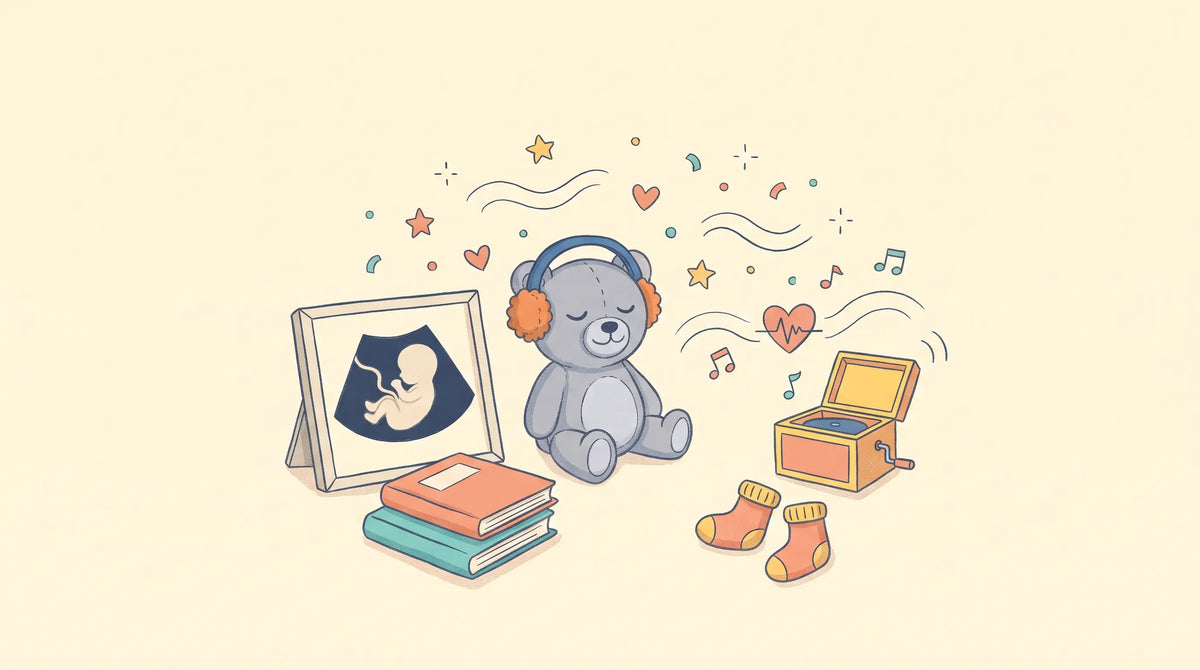
The short answer: around weeks 16 to 20 of pregnancy, the inner ear is developed enough for the first sounds from the mother’s body to reach it. Around week 24, babies start to react to sounds from outside, and in the last trimester studies show clear reactions to voices. The mother’s voice comes through best of all.
Here you will find out how hearing develops week by week, what your baby actually hears in the womb, what studies show about the time after birth and when things get too loud.
At a glance
- Around weeks 16 to 20, the inner ear is developed enough for the first sounds to reach it. An ultrasound study observed the earliest reaction to a low tone at 19 weeks.
- Around week 24, babies start to react to sounds from outside. In the last trimester, studies show clear reactions to voices.
- It is never quiet in the womb: heartbeat, rushing blood and digestion can be heard all the time. From outside, mainly low tones get through, while high tones are muffled more strongly.
- The mother’s voice is also transmitted through her body and therefore comes through particularly well.
- Newborns prefer their mother’s voice. Small studies also found traces of melodies and stories from pregnancy.
- Playing music to your bump is an option, not a must. Do not put headphones on your bump, and avoid very loud surroundings and booming bass.
When can babies hear in the womb? Development week by week
Depending on the source, you will read different weeks, anywhere from week 16 to week 28. This is less down to contradictory studies than to what is meant by “hearing”: that sounds can reach the inner ear at all, that the baby reacts measurably to a tone, or that it perceives sounds from outside the mother’s body. The overview puts the figures into context.
| Week of pregnancy | What happens during this time |
|---|---|
| around week 16 | The inner ear is developed enough for the first sounds from the mother’s body to reach it, such as the rushing of blood (BARMER). Other specialist sources give weeks 17 to 20 for this (Austrian health portal). |
| weeks 17 to 20 | The inner ear begins to connect with the brain, according to Sana Kliniken around week 18. A well-known ultrasound study observed the earliest reaction to a sound at 19 weeks: a loudspeaker on the bump played a low tone of 500 Hz, and the baby moved (Hepper and Shahidullah, 1994). This is the earliest finding under test conditions, not an average. |
| weeks 21 to 24 | Babies now react to sounds from outside, for example with movements. The US occupational safety institute NIOSH gives week 24 as the approximate starting point. |
| weeks 25 to 28 | Hearing continues to mature, and over time quieter and quieter sounds are enough to trigger a reaction. At 27 weeks, 96 per cent of the babies in the ultrasound study reacted to low tones of 250 and 500 Hz, but none yet to high tones (Hepper and Shahidullah, 1994). |
| weeks 29 to 35 | Gradually, babies also react to higher tones. At 33 weeks, all babies in the study reacted to 1,000 Hz, and at 35 weeks to 3,000 Hz as well (Hepper and Shahidullah, 1994). |
| final weeks until birth | For weeks, the baby hears the same voices, songs and sounds. In a study with 60 babies shortly before birth, their heart rate rose when they heard a recording of their mother’s voice and fell when they heard an unfamiliar woman’s voice (Kisilevsky et al., 2003). |
Good to know: Every baby develops at their own pace. The week figures come from studies and specialist sources. They are guidelines, not limits that your baby has to meet exactly.
What does the baby hear in the womb?

The womb is not a quiet place. Tissue, amniotic fluid and the abdominal wall muffle sounds from outside, but they cannot shut them out completely. Low tones get through almost unmuffled, while high tones are weakened more strongly (Richards et al., 1992).
Sounds from the mother’s body
The loudest sounds for your baby are the ones very close by: your heartbeat, the rushing of blood in your vessels, your breathing and your digestion. This steady background noise accompanies your baby from the moment they can hear until birth. Some parents take this as an explanation for why newborns often find steady sounds pleasant. You can read more about this in our guide to white noise for babies.
The mother’s voice
Your voice has a special status. It does not just come from outside through the abdominal wall, it is also transmitted through your body. In measurements inside the womb, the mother’s voice actually arrived slightly louder on average than outside, while other people’s voices arrived slightly quieter (Richards et al., 1992). So your baby hears other voices more quietly and, above all, less clearly.
Other voices and sounds from outside
The voice of a partner or siblings also gets through, especially in the last trimester. Low tones and vowels are easy to hear, whereas high, hissing sounds such as an “s” are hard to make out. So your baby does not understand words, but picks up the melody, rhythm and stress of speech.
Music
Your baby hears music in a similar way to voices: rhythm and melody get through, but muffled and without the bright overtones. In the womb, a song sounds roughly as if you were hearing it through a closed door.
What babies take with them from the womb: what studies show
That babies hear in the womb is well documented. The more exciting question is whether anything of it remains after birth. There are a few well-known studies on this, mostly with small numbers of babies:
- The mother’s voice: In a classic study, newborns preferred their mother’s voice to an unfamiliar woman’s voice within their first days of life (DeCasper and Fifer, 1980).
- A story read aloud: Mothers read the same story aloud every day during the last six weeks of pregnancy. After birth, the babies showed a preference for exactly this text, even when someone else read it (DeCasper and Spence, 1986).
- The native language: Researchers compared the cries of 30 German and 30 French newborns in their first days of life. The French babies more often cried with a rising melody, the German babies more often with a falling one, matching the typical speech melody of each language (Mampe et al., 2009). This is a difference between the groups, not one found in every single baby.
- Words and melodies: Finnish researchers had babies in the last trimester regularly hear a made-up word or a melody. In two small studies, each with a control group, they found signs in the brain waves after birth that the babies processed these sounds differently from babies who did not know them (Partanen et al., 2013). The melody still left traces in memory at four months. The studies measured brain waves, not sleep or settling.
To be honest: These studies show that babies learn from what they hear even before birth. However, the evidence is thin: a systematic review in 2023 found only eight suitable studies, with very different methods and mostly a high risk of bias (Movalled et al., 2023). They do not show that music in the womb makes children cleverer, calmer or better sleepers. According to current knowledge, there is no “Mozart effect” for unborn babies. So your baby does not need a programme: your voice in everyday life, the sounds of your body and your normal surroundings are enough for hearing to develop (Graven, 2000).
Should you play music to your baby in the womb?

You can, but you do not have to. Many pregnant women enjoy taking time for their baby in the evening, with a song, a music box or a story. For you, this can be a lovely ritual to build a bond even before birth.
Which music you choose is a matter of taste. It does not have to be classical. The most pleasant pieces are calm ones that you enjoy listening to yourself, because your baby picks up on your relaxation. If you play a particular melody regularly in the last few weeks, you can keep using it after birth, for example as part of your bedtime routine. However, there is no evidence that this helps your baby settle more easily.
Important: Do not place headphones or speakers directly on your bump. Experts explicitly advise against this (Graven, 2000), and it is not necessary either, as music at normal room volume gets through anyway. Directly on the bump, the sound reaches your baby more strongly than you hear it yourself.
You can read how music boxes work, which melodies are suitable and why some parents place them on the bump in our guide to music boxes for babies.
How loud is too loud for the baby in the womb?
Your bump protects your baby from a lot, but only partly from very loud noise. Low, thumping tones in particular are hardly muffled. For everyday life, this means that conversations, music at room volume, traffic noise or a vacuum cleaner are considered harmless. Caution is advised with very loud, long-lasting or heavily booming noise.
- Avoid extremely loud places: The US occupational safety institute NIOSH advises pregnant women to avoid areas above 115 dB(A) completely, even with hearing protection. That is about as loud as a chainsaw. The value is an upper limit, not the threshold up to which noise is harmless.
- Avoid booming bass: Low tones that you feel as a boom or vibration pass through the body more easily than high ones. A US expert group advises avoiding prolonged low tones above 65 dB(A) during pregnancy (Graven, 2000), for example directly in front of large speakers or subwoofers.
- Do not lean against sources of noise: The closer your bump is to a source of noise, the more strongly the sound reaches your baby. So do not lean against loud or vibrating machines or large speakers.
- Concerts in moderation: In the view of experts, one or two concerts are unlikely to be a problem, but you should avoid regular very loud events during pregnancy. Keep your distance from the speakers and avoid clubs with very heavy bass.
Good to know: Do you work in a noisy environment, for example in manufacturing, in hospitality or in a nursery? In Germany, the Maternity Protection Act requires your employer to check whether the noise poses a risk to you or your child. In the practice of the German occupational safety authorities, pregnant women may not be employed if the noise, averaged over the working day, exceeds 80 dB(A). Hearing protection is not a solution here, because it does not protect your baby sufficiently. Other countries have their own rules. Wherever you work, raise the subject early, for example with your occupational health doctor or your gynaecologist.
7 ideas for lovely listening moments during pregnancy
You do not need anything special for this. These ideas take little time and are often good for you too:
- Tell your baby about your day. Your baby will not understand the words, but hears your voice in all its moods.
- Let your partner join in. By the last trimester at the latest, their voice gets through too. A few sentences or a song in the evening quickly become a shared ritual.
- Read the same story aloud again and again. A short picture book that you keep reading after birth connects both times.
- Pick a song for the two of you. Whether it is a lullaby, a pop song or a music box melody: whatever you like is right.
- Involve siblings. Big brothers and sisters can sing to the baby or tell them something. This also helps them get ready for the baby.
- Treat yourself to quiet breaks. Soft music, your hand on your bump, a few minutes just for the two of you.
- Stick to normal volume. Better quietly in the room than loudly on the bump.
Using Lenabo even before birth

A Lenabie can be there even in the last weeks of pregnancy. Every Lenabie is a soft cuddly toy with its own character. Together with the Lenabo Smart Speaker, it plays content, for example white noise and bedtime music for the time from birth onwards. This way, you can play a calm melody in the room in the evening and keep using it in the bedtime routine after birth, and the cuddly toy is already there when your baby arrives.
Later, the Lenabie grows with your child: music is joined by bedtime stories, audio plays and learning content. The familiar cuddly toy stays, while the content changes with age. You can see what content is available in the overview of digital content.
Important for babies: The speaker’s maximum volume is limited to 85 dB, measured at a distance of 50 cm. This is a technical upper limit, not a recommendation. During pregnancy, set the speaker as quietly as possible and at a distance, not directly against your bump. In the first year of life, the Lenabie stands at a distance next to the cot, not in it, and here too the rule is: as quietly as possible. With the sleep timer, you can limit how long it plays.
To be honest: There is no evidence that your baby will sleep better after birth because they already know a melody from the womb. A small study found signs that a melody babies heard regularly in the last trimester still leaves traces in memory at four months; the study measured brain waves, not sleep or settling. The Lenabie is a lovely way to create a ritual, but it does not replace your own voice.
Price: The Starter Kit with smart speaker and a Lenabie costs €99.99 at the regular price. Each additional Lenabie costs €39.99, with cuddly toy, its own voice and 90 minutes of content. One speaker is enough for all Lenabies, including those of siblings.
View Starter Kits · All Lenabies
You will find more ideas for the time before birth in our gifts for pregnant women.
After birth: how hearing continues to develop

At birth, hearing is already well developed. In Germany, a hearing screening is part of the early detection check-ups for newborns: it takes place within the first three days of life if possible, often while still in hospital, and does not hurt. For premature babies, it is done by the original due date at the latest. Many other countries, including the UK, also offer newborn hearing screening.
In the first months, your baby learns to tell voices and sounds apart better and better. Your baby turns their head towards sounds, listens to your voice and soon starts to babble. Talking, singing and reading aloud are the best support for this. Our guide to language development in children shows how things continue from there.
Tip: If your baby hardly reacts to loud noises or to your voice, have this checked by your paediatrician promptly, even if the hearing screening was normal.
Conclusion: your baby listens to you long before birth
Around weeks 16 to 20, the first sounds reach your baby. From about week 24, your baby reacts to sounds from outside, and in the last weeks already perceives voices, music and stories clearly, if muffled. After birth, your voice is the most familiar of all. Your baby does not need a special programme for this: talk to your baby, sing something when you feel like it and avoid very loud surroundings. Everything else can simply be lovely.
Frequently asked questions
From which week of pregnancy can the baby hear the mother’s voice?
The first sounds from the mother’s body can reach the baby around weeks 16 to 20. The mother’s voice comes through particularly well because it is also transmitted through her body. Studies show clear reactions to voices mainly in the last trimester of pregnancy.
Can the baby in the womb hear Dad too?
Yes, especially in the last trimester of pregnancy. His voice arrives more muffled than the mother’s, because it only gets through the abdominal wall from outside. In one study, babies in the womb reacted to recordings of both parents with a faster heartbeat. After birth, however, they preferred the mother’s voice (Lee and Kisilevsky, 2014).
Will my baby recognise my voice after birth?
Studies show that newborns prefer their mother’s voice to an unfamiliar voice within their first days of life. So the voice your baby has heard in the womb for months is a familiar one.
What music do babies in the womb like?
There is no particular style of music that is especially good. Calm music at room volume that you like yourself is a good choice. In the womb, mainly rhythm and melody get through, and only in muffled form.
Can you put headphones on your baby bump?
Experts advise against it. It is not necessary, because music in the room gets through anyway, and directly on the bump the sound reaches the baby more strongly than you might think. It is better to play music quietly in the room.
How do babies in the womb react to a music box?
From about week 24, babies can react to sounds from outside, some with movements. Your baby hears a music box nearby in muffled form, and how they react varies from baby to baby. However, a music box is not a test of your baby’s hearing or wellbeing. If you notice that your baby is moving less or differently than usual overall, contact your midwife, your gynaecologist or the hospital straight away.
Can noise harm the baby in the womb?
Very loud or long-lasting noise can put a strain on the baby’s hearing, especially low tones, because the bump hardly muffles them. Everyday noises are considered harmless. You should avoid extremely loud places above 115 dB(A) and prolonged booming bass. At work, a limit of 80 dB(A), averaged over the working day, generally applies to pregnant women in Germany.
Sources and last updated
Hepper, P. G. and Shahidullah, B. S. (1994): Development of fetal hearing. Archives of Disease in Childhood, Fetal and Neonatal Edition, 71(2), F81-F87. pubmed.ncbi.nlm.nih.gov/7979483
Richards, D. S., Frentzen, B., Gerhardt, K. J., McCann, M. E. and Abrams, R. M. (1992): Sound levels in the human uterus. Obstetrics and Gynecology, 80(2), 186-190. pubmed.ncbi.nlm.nih.gov/1635729
DeCasper, A. J. and Fifer, W. P. (1980): Of Human Bonding: Newborns Prefer Their Mothers’ Voices. Science, 208(4448), 1174-1176. pubmed.ncbi.nlm.nih.gov/7375928
DeCasper, A. J. and Spence, M. J. (1986): Prenatal maternal speech influences newborns’ perception of speech sounds. Infant Behavior and Development, 9(2), 133-150. doi.org/10.1016/0163-6383(86)90025-1
Kisilevsky, B. S. et al. (2003): Effects of experience on fetal voice recognition. Psychological Science, 14(3), 220-224. pubmed.ncbi.nlm.nih.gov/12741744
Lee, G. Y. and Kisilevsky, B. S. (2014): Fetuses respond to father’s voice but prefer mother’s voice after birth. Developmental Psychobiology, 56(1), 1-11. pubmed.ncbi.nlm.nih.gov/23817883
Mampe, B., Friederici, A. D., Christophe, A. and Wermke, K. (2009): Newborns’ cry melody is shaped by their native language. Current Biology, 19(23), 1994-1997. pubmed.ncbi.nlm.nih.gov/19896378
Partanen, E. et al. (2013): Learning-induced neural plasticity of speech processing before birth. PNAS, 110(37), 15145-15150. pubmed.ncbi.nlm.nih.gov/23980148
Partanen, E., Kujala, T., Tervaniemi, M. and Huotilainen, M. (2013): Prenatal Music Exposure Induces Long-Term Neural Effects. PLOS ONE, 8(10), e78946. doi.org/10.1371/journal.pone.0078946
Movalled, K., Sani, A., Nikniaz, L. and Ghojazadeh, M. (2023): The impact of sound stimulations during pregnancy on fetal learning: a systematic review. BMC Pediatrics, 23, 183. pmc.ncbi.nlm.nih.gov/articles/PMC10116668
Graven, S. N. (2000): Sound and the Developing Infant in the NICU: Conclusions and Recommendations for Care. Journal of Perinatology, 20(Suppl. 1), S88-S93. doi.org/10.1038/sj.jp.7200444
Moon, R. Y. et al., American Academy of Pediatrics (2022): Sleep-Related Infant Deaths: Updated 2022 Recommendations for Reducing Infant Deaths in the Sleep Environment. Pediatrics, 150(1), e2022057990. pubmed.ncbi.nlm.nih.gov/35726558
CDC/NIOSH: About Noise and Reproductive Health (as of 15 December 2023). cdc.gov
BARMER: Pregnancy week 16 (updated 25 February 2022, in German). barmer.de
Austrian health portal (Gesundheitsportal Österreich): Development of an embryo week by week (updated 11 May 2020, in German). gesundheit.gv.at
Sana Kliniken Landkreis Biberach: The development of the senses (in German). sana.de
Apotheken Umschau: What does the foetus hear in the womb? (updated 4 October 2017, in German). apotheken-umschau.de
Apotheken Umschau: What unborn babies love (updated 24 June 2021, in German). apotheken-umschau.de
German Maternity Protection Act (Mutterschutzgesetz), Section 10 (assessment of working conditions; protective measures, in German). gesetze-im-internet.de
German Maternity Protection Act (Mutterschutzgesetz), Section 11(3) (noise as a physical agent, in German). gesetze-im-internet.de
KomNet NRW: Is it permissible for a pregnant employee to spend time in noise areas temporarily? (Dialogue 23777, as of 6 October 2024, with reference to the IFA limit value list, in German). komnet.nrw.de
Royal College of Obstetricians and Gynaecologists (RCOG): Your baby’s movements in pregnancy (February 2019). rcog.org.uk
BIÖG, kindergesundheit-info.de: The infant’s sense of hearing (as of 29 April 2026, in German). kindergesundheit-info.de
Federal Joint Committee (G-BA): Children’s Directive including newborn hearing screening (in force since 20 August 2026, in German). g-ba.de
This article does not replace medical advice. If you have any questions about your pregnancy, please contact your gynaecologist or your midwife.
Last updated: November 2026
